Login/Register


 Trishul Defence Academy
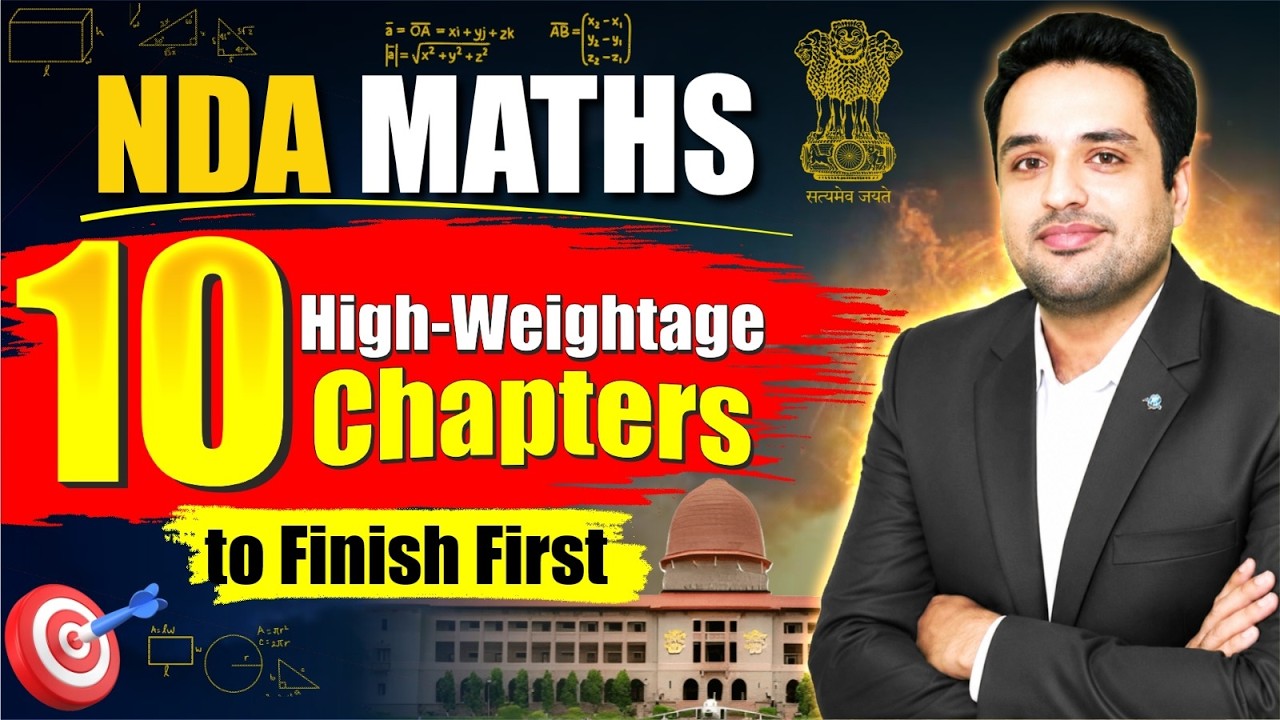
Here is a hard truth most students learn too late. NDA Maths has 120 questions, 300 marks and just 150 minutes. That is about 75 seconds per question, with 0.83 marks cut for every wrong answer.
You cannot study every chapter with equal effort and win that race. The toppers don’t. They finish the chapters that carry the most marks first, then build outward.
But there is a second trap. Even in the “important” chapters, UPSC is changing how it asks. Our academic team compared the NDA 2025-I paper with the 2026 paper (Set D), chapter by chapter. The chapters stayed the same. The skills being tested did not.
So this guide gives you two things: the 10 NDA maths important chapters to finish first, and the one new skill inside each chapter you must not miss.
The 10 chapters at a glance
| Rank | Chapter | Tier | The new skill the 2026 paper tested |
| 1 | Trigonometry | Highest weightage | Reducing large angles first; counting solutions in a range |
| 2 | Matrices & Determinants | Highest weightage | Formula reasoning without computing the matrix |
| 3 | Probability & Statistics | Highest weightage | Ranked-value (“order statistics”) counting |
| 4 | Sets & Relations | Highest weightage | Pure definition-based statements |
| 5 | Functions | Mid weightage | Short standalone “trick” items |
| 6 | Integral Calculus | Mid weightage | Spotting a disguised derivative |
| 7 | Straight Lines | Mid weightage | Reflection (image point) and locus |
| 8 | Sequences & Series | Mid weightage | Relations between Sₙ, S₂ₙ, S₃ₙ |
| 9 | Permutation & Combination | Mid weightage | Complement counting (“at least one”) |
| 10 | Differentiation | Mid weightage | Differentiability of |x|-type functions |
Tier 1: The four chapters that decide your score
1. Trigonometry
What changed: Earlier papers leaned on standard identities and special angles. The 2026 paper added two skills: simplifying large angles like tan 1125° or cot 405° by reducing them first, and counting how many solutions an equation has between 0° and 360°.
How to study it:
- Practise a “reduce before you solve” drill. Bring every big angle down to its basic angle before using any identity.
- Treat solution-counting as a separate skill. Don’t stop at one root; think about how the graph repeats.
Smart tool: Use a unit-circle tool on Desmos or GeoGebra. Drag an angle past 360° and watch it land on the same point.
2. Matrices & Determinants
What changed: In 2025-I, you mostly calculated: multiply matrices, expand determinants. In 2026, many questions asked you to reason with formulas alone, such as |adj A| = |A|ⁿ⁻¹, or to judge statements like “does AB = AC always mean B = C?”
How to study it:
- Split the chapter into two tracks: “compute it” and “reason with formulas”.
- For the second track, build a one-page formula card for adjoint, inverse and determinant properties. Revise it daily.
Smart tool: A flashcard app with spaced repetition. This track rewards instant recall under time pressure.
3. Probability & Statistics
What changed: 2025-I was mostly mean, median, variance and standard probability. 2026 brought a new type: pick some numbers from a set and find the chance that the smallest is a given value. It also tested chains of three events.
How to study it:
- Treat ranked-value problems as a new topic: count the favourable choices, then divide by ⁿCₖ.
- For three-event problems, write every given value first, mark what is independent, then link them step by step.
Smart tool: A spreadsheet that calculates mean and variance. Solve by hand, then check where your steps differ.
4. Sets & Relations
What changed: Missing from 2025-I, it returned strongly in 2026, built on pure definitions: reflexive, symmetric, transitive, range vs codomain, and whether a set of pairs is a function.
How to study it: This is a recall chapter, not a problem-solving one. Short daily quizzes beat long sessions.
Smart tool: A quick auto-graded quiz (Google Forms works) that shows the right answer and a one-line reason instantly.
Tier 2: The six chapters that separate good from great
5. Functions
What changed: 2025-I used long, multi-part question blocks. 2026 used short, standalone “trick” questions.
How to study it: Prepare both ways: full worked blocks for depth, and quick trick drills for speed.
Smart tool: Plot each function on Desmos to estimate domain and range before you calculate.
6. Integral Calculus
What changed: 2026 hid standard results in plain sight. For example, xˣ(1 + ln x) is simply the derivative of xˣ.
How to study it: Before integrating anything, ask: “Whose derivative is this?” Use a worksheet that only asks you to spot the match.
Smart tool: Check your work on WolframAlpha step-by-step, but only after you have tried the recognition step yourself.
7. Straight Lines (2D Coordinate Geometry)
What changed: Beyond distance and line equations, 2026 asked about a light ray reflecting off the x-axis, and about finding a locus from a condition.
How to study it:
- Learn the image-point method as a fixed routine: reflect the point, then join it to the target.
- For locus: name the moving point (h, k), turn the condition into an equation, simplify.
Smart tool: GeoGebra. Drag a point and watch its reflection or locus trace live.
8. Sequences & Series
What changed: Less “identify the AP or GP”, more working with relations between Sₙ, S₂ₙ and S₃ₙ.
How to study it: Give one full session only to these sum relations. It is a separate skill from knowing the formulas.
Smart tool: A spreadsheet where you enter a and d (or a and r) and see Sₙ, S₂ₙ and S₃ₙ fill in. Spot the pattern, then prove it.
9. Permutation & Combination
What changed: The 2026 question used complement counting: “at least one digit repeated” equals total minus all-different.
How to study it: Learn one rule. When you see “at least one”, count the opposite first.
Smart tool: None needed. Volume of practice is the tool.
10. Differentiation and Differentiability
What changed: 2026 focused on whether a function like p|x| + q can be differentiated at a point, not just on applying rules.
How to study it: For every |x|-type function, compare the left-hand and right-hand derivatives. If they differ, the derivative does not exist there.
Smart tool: Graph it on Desmos. The sharp corner shows you the answer before the algebra does.
The pattern behind all 10 chapters
Look closely and one message repeats. UPSC is moving from “can you calculate?” to “do you understand?”
- Recognise before you solve: disguised derivatives, perfect squares, large angles.
- Reason, don’t just compute: matrix properties, differentiability, definitions.
- Use named strategies: image points, complements, “at least one”.
Students who only re-solve old worked examples will feel the paper got harder. Students who practise these skills will feel it got fairer.
Expert insights: how our toppers use this list
- Finish order matters. Close all four Tier 1 chapters before going deep into Tier 2. A half-done Trigonometry costs more than an untouched Conic Sections.
- One new skill per chapter. For each chapter, write the “new skill” from the table on top of your notes page. Practise it until it feels routine.
- Accuracy beats attempts. With 0.83 marks lost per wrong answer, 80 sure answers beat 110 guesses.
- Mock tests are mirrors. After every mock, tag each wrong answer to a chapter. Your weakest high-weightage chapter is your next study target.
Frequently asked questions
Which are the most important chapters in NDA Maths?
Trigonometry, Matrices & Determinants, Probability & Statistics and Sets & Relations are the highest-weightage group. Functions, Integral Calculus, Straight Lines, Sequences & Series, Permutation & Combination and Differentiation follow closely.
Can I clear NDA Maths by studying only these 10 chapters?
These 10 give you the strongest base, but don’t skip the rest entirely. Lower-weightage chapters like Vectors, 3D Geometry and Complex Numbers still appear and can be quick marks once your core is solid.
Is NDA Maths getting harder?
It is getting more concept-based. Questions test whether you understand an idea, not only whether you can repeat a calculation. Practising the “new skill” in each chapter prepares you for this shift.
How long does it take to finish these chapters?
It depends on your class and base. Students starting in Class 11 can cover them comfortably alongside board studies with a fixed daily routine. A chapter tracker helps you see real progress week by week.
Do non-science students need to clear the same Maths paper?
Yes. Arts and Commerce students applying for the Army wing take the same Maths paper, so this priority list matters even more for them.
Download your free NDA Maths chapter tracker
Knowing the 10 chapters is step one. Finishing them is what changes your score.
Our free NDA Maths Chapter Tracker helps you:
- Tick off each of the 10 chapters, theory to practice to revision
- Log the “new skill” for every chapter and mark it mastered
- Track mock-test errors chapter by chapter
- See at a glance which chapter to study next
Print it, stick it on your wall, and watch the gaps close.
[Download the chapter tracker →] Click Here