Login/Register

 Trishul Defence Academy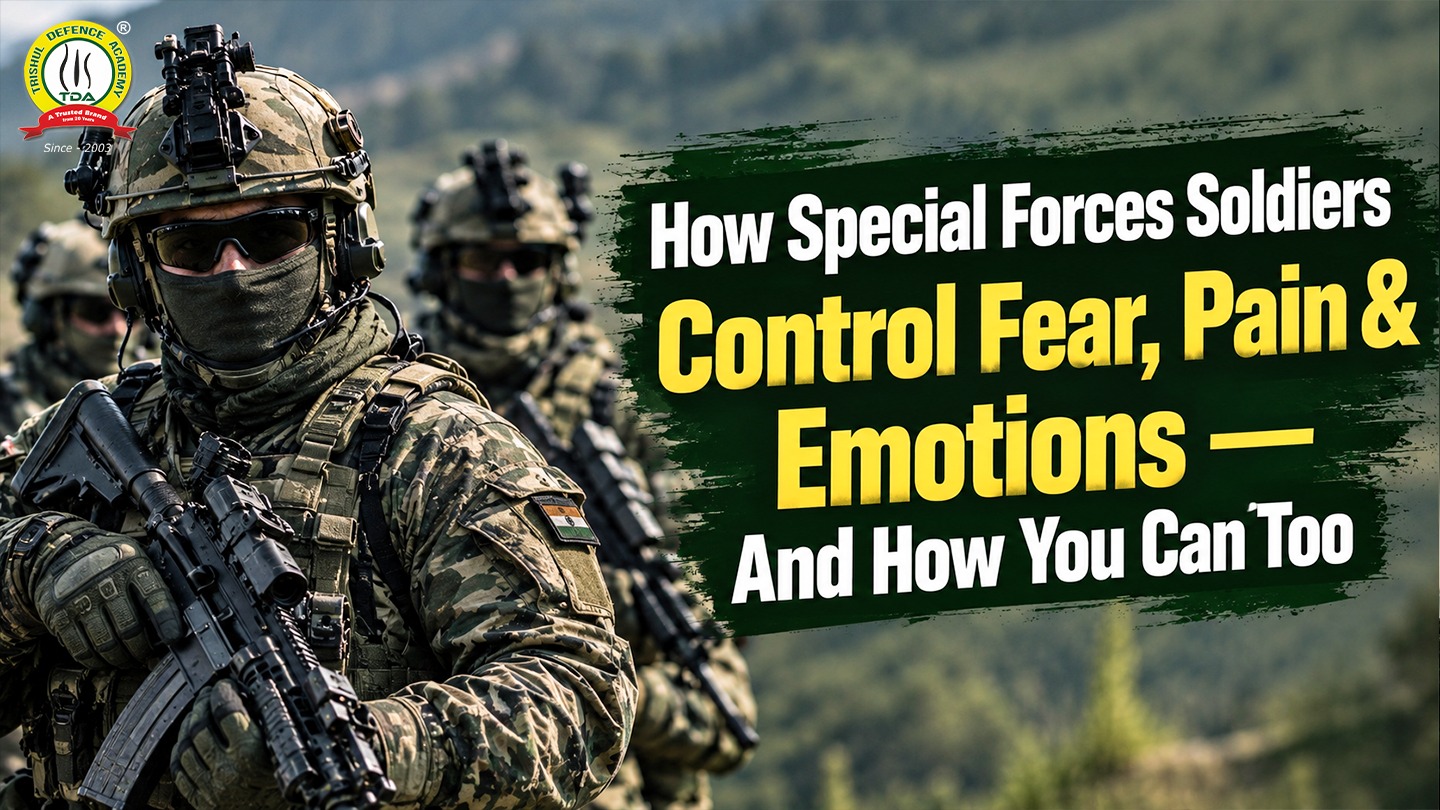
Why Does a Soldier Stay Calm When Everything Falls Apart?
Picture two people getting brutal news in the same minute — a canceled deal, a fight with family, a sudden financial hit. One spirals. The other pauses, breathes, and acts.
What’s the difference? It’s not bravery. It’s not toughness. According to Major SS Sambyal — an alumnus of the National Defence Academy, a former Special Forces officer, and past Aide-de-Camp to the President of India — it’s something far more learnable: tactical psychology.
Most people assume a “military mindset” means rigid discipline or physical grit. Major Sambyal defines it differently: it’s the trained ability to think clearly and logically when everything around you is in complete chaos.
The good news? You don’t need a uniform to build it.
What Is Tactical Psychology, Really?
Tactical psychology is the trained mental skill of:
- Staying calm under extreme pressure
- Anticipating volatile situations before they explode
- Reading people and emotional shifts accurately
- Using rehearsed mental tools to steer toward a good outcome
In combat, this is survival. In civilian life, it’s the same skillset applied to your job, your relationships, your money stress, and your self-doubt.
The 5 Pillars of the Military Mindset
Pillar 1: Emotional Discipline
Soldiers are trained to move from emotional reacting to logical responding. Three tools make this possible:
- The 3-Second Pause Rule — Before reacting in an argument or crisis, pause for 2–3 seconds. That tiny gap is enough for your brain to shift from impulse to logic.
- Tactical (Box) Breathing — Inhale for 4 seconds, hold for 4, exhale for 4. This single pattern resets your nervous system and dials down panic or anger almost instantly.
- Eliminating Ego — Ego clouds judgment. Removing it lets you focus purely on solving the actual problem in front of you.
Pillar 2: Situational Awareness
A trained mind is always reading the room — people’s tone, body language, and shifting motives — before conflict erupts.
Major Sambyal recalls being stranded with his team in a dangerous contingency in the North. As commander, he refused to let panic take over and instead anchored his team on one clear, positive objective: getting every soldier home safely. That single mental shift — rejecting the spiral, holding the goal — is a tool anyone can use in a crisis.
Pillar 3: Stress Inoculation
The core principle here is simple: train your mind before life tests it.
Soldiers are deliberately exposed to controlled stress until it becomes familiar. Civilians can build the same resilience through:
- Voluntary discomfort (cold showers, disrupted routines, tough physical goals)
- Target-driven challenges (finishing a book, running 10 km, giving a public talk)
- Learning a new skill every 10–20 days to keep the brain adaptable
Pillar 4: Teamwork, Trust & Confidence
No Special Forces mission is won solo. Success depends on total mutual trust. In civilian life, this means deliberately building a support system — family, mentors, colleagues — through consistent communication and reliability, not luck.
Pillar 5: Mission Clarity — Know Your “Why”
Every operation has one non-negotiable: absolute clarity of purpose. Civilians should ask themselves daily: “Why am I doing this?” When the reason is crystal clear, discipline stops feeling like effort.
The Tactical Toolkit: 5 Tools You Can Use Today
| Tool | What It Means | How to Use It in Real Life |
| 3-Second Rule | Pause 2–3 seconds before reacting | Stops impulsive outbursts in arguments |
| 5×5 Rule | If it won’t matter in 5 years, don’t give it more than 5 minutes | Kills mental energy waste on small annoyances |
| Box Breathing | 4s inhale, 4s hold, 4s exhale | Calms nerves before a big meeting or event |
| Red Team Thinking | Ask “Why? Why? Why?” from your opponent’s view | Exposes weak spots in your own plan |
| After Action Review (AAR) | Split a page into Weaknesses (left) and Strengths (right) | Turns daily mistakes into daily growth |
4 Mindset Shifts That Separate Reactive People From Resilient Ones
| Dimension | Reactive Mindset | Resilient Mindset |
| Cognitive Processing | Reacting on raw emotion | Pausing to think logically |
| Comfort Zone | Avoiding all discomfort | Choosing voluntary hardship |
| Responsibility | Blaming circumstances | Owning the outcome fully |
| Execution | Rushing and making errors | Moving with precision over speed |
Real Lessons From the Field
- Heartbreak and overthinking? You can’t force your mind to stop — but you can redirect it into structured, physical, or intellectual tasks that anchor your attention.
- Facing extreme fear? Focus on positive anchors — family, duty, purpose — instead of the fearful outcome itself.
- Think you’re too old to change? Major Sambyal is direct: age is a mental constraint, not a real one. Structure and determination decide what’s possible, not birth year.
Expert Insights & FAQs
Q: Can civilians actually learn tactical psychology without military training?
Yes. The core tools — the 3-second pause, box breathing, and stress inoculation — are mental techniques, not physical ones. Anyone can practice them starting today.
Q: How long does box breathing take to work?
Most people feel a noticeable calming effect within one full cycle (about 12 seconds), though building lasting emotional control takes consistent daily practice.
Q: What’s the easiest pillar to start with?
Emotional Discipline. The 3-second pause rule requires no equipment, no training, and can be used in your very next stressful conversation.
Q: Is “voluntary discomfort” the same as being reckless?
No — it’s controlled, deliberate exposure to manageable stress (like a cold shower or a hard workout), not unnecessary risk-taking.
The Final Step: Your One Challenge Today
You don’t need a war zone to build a war-ready mind. Pick one voluntary discomfort challenge today — a cold shower, an uncomfortable conversation you’ve been avoiding, or five extra minutes of a tough workout — and treat it as training.
That’s how soldiers build calm under fire. That’s how you’ll build calm under everyday pressure too.