Login/Register


 Trishul Defence Academy
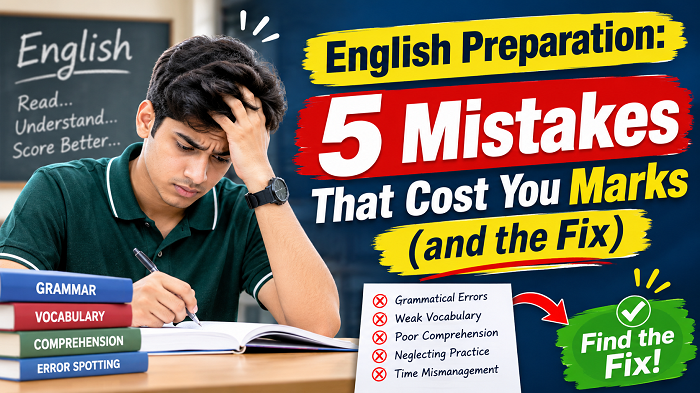
The Problem: Hard Work Is Not the Same as the Right Work
English educator makes this exact point on the biggest English mistakes in competitive exams (NDA and CDS are named in it). His core idea is simple: students rarely fail English because it is too hard. They fail because they repeat flawed habits for one or two years before they notice.
That delay is the real cost. A flawed method does not feel flawed. It feels like effort, and effort feels like progress.
Why English deserves your serious attention
- English is Part A of the NDA General Ability Test: 50 questions, 200 marks. That is about 22% of the 900 marks in the written exam (Maths 300 + GAT 600).
- Wrong answers cost you marks. NDA uses negative marking of one-third, so a guess that goes wrong hurts twice: you lose the chance and the marks.
- English is the section where method beats talent. Unlike a topic you never studied, English rewards a smarter system within weeks.
What is really stopping you
It is rarely laziness. Three things stop most aspirants:
- Borrowed methods. You study English like General Studies: memorise, revise, repeat. It worked for other subjects, so you never question it.
- Fake progress signals. Mocks, word counts and pages read all give a feeling of moving forward, even when your accuracy has not changed.
- Too many voices. Ten teachers, five PDFs and a Telegram group each give a different shortcut, so you never settle on one.
Now let us look at the five mistakes these three causes create.
The Strategy: 5 Mistakes, 5 Fixes
Mistake 1: Memorising grammar rules like General Studies
The trap: You collect 100 to 200 rules per chapter and drill practice sets. It works on easy questions. Then a tougher question arrives, with a twisted sentence, and the memorised rule does not match.
What is stopping you: Examiners do not test whether you remember a rule. They test whether you understand the sentence: its context, its logic and its structure.
The fix:
- Master the foundation first: subject, object, verb, subject complement, phrases and clauses.
- Ask “why” about every answer. Why is this verb singular? Why is an adverb used here and not an adjective?
- Remember the principle: over 90% of English grammar rules come from logic. When you see the logic, you do not need to memorise the rule.
Image idea: Split graphic. Left: a wall of 200 rules. Right: one sentence broken into subject, verb and object. Alt text: Comparison of memorising many grammar rules versus understanding one sentence structure.
Mistake 2: Learning vocabulary from lists, without context
The trap: You memorise 50 words a day from a list with Hindi meanings only. You believe vocabulary matters only in synonym and antonym questions.
What is stopping you: Vocabulary hides inside reading comprehension, cloze tests, para-jumbles and error spotting too. A word known only as a Hindi meaning breaks down the moment the sentence changes.
The fix:
- Study each word with its part of speech, English meaning, situation of use, tone and near synonyms.
- Write at least one sample sentence of your own for every new word.
- Keep going every day until your final selection day. Vocabulary is a habit, not a weekend project.
Mistake 3: Treating reading comprehension as speed reading
The trap: You skim the passage at top speed, then hunt for answers. You miss the author’s tone (critical, sarcastic, neutral) and the flow of the argument.
What is stopping you: Rushing feels efficient, but it leaves you confused when the questions arrive. Speed is the result of practice. It cannot be forced on day one.
The fix, the Notebook Gist Technique:
- Read one passage every day, slowly and actively.
- Write a 3 to 5 line gist in a notebook: the main idea, the author’s tone, the flow.
- Repeat for 10 consecutive days. Your brain starts catching the core theme automatically.
Why it pays: Grasping the main idea can unlock up to 70% of the comprehension questions.
Image idea: A notebook page with a passage on the left and a 4-line gist on the right. Alt text: Notebook showing a short gist written after reading a comprehension passage.
Mistake 4: Giving endless mocks without analysis
The trap: You attempt two or three mocks a day and feel productive. But an unanalysed mock only repeats your mistakes. Fifty mocks can mean the same error fifty times.
What is stopping you: The mock score gives you a feeling of progress, so you never stop to ask why you lost marks.
The fix, the 10 beats 50 rule: Ten mocks with deep analysis beat fifty without it. The source illustrates this with roughly 88% accuracy for the analysed group against about 45% for the unanalysed one. Treat those numbers as an illustration of the gap, not a guarantee.
After every mock, sort each wrong or skipped question into one of four boxes:
- Concept gap: a grammar chapter you have not understood.
- Vocabulary gap: a word or usage you did not know.
- Reading gap: you misread the passage or its main idea.
- Silly error: you knew it, but slipped.
Then revise only the weak topics before the next mock. Under NDA’s negative marking, this step also tells you which guesses to stop making.
Mistake 5: Hopping between teachers and resources
The trap: You watch ten YouTube channels, collect Telegram PDFs and change strategy every month. Your notes are scattered and your clarity is zero.
What is stopping you: Every new resource feels like a missing piece. In reality it is mental overload, and overload shows up as confusion and negative marks.
The fix, the 80/20 rule:
- Finish 80% of your core syllabus with one primary educator, chosen for conceptual clarity and question-solving accuracy, not marketing claims.
- Use other resources only to fill the remaining 20% of gaps.
- Build speed through your own practice. Teachers can give you clarity and accuracy, but only your practice gives you speed.
Your Preparation Matrix and 30-Day Plan
Here is the whole strategy on one page.
| Pillar | Flawed approach | Corrective action | Expected outcome |
| Grammar | Memorise 200 rules per chapter | Learn subject, verb, clause basics; ask “why?” | Accuracy even on tough, twisted questions |
| Vocabulary | Hindi-meaning word lists | Context + part of speech + own sentence + near synonyms | Better scores in RC, cloze and error spotting |
| Reading comprehension | Fast skimming without tone | Slow reading; 3 to 5 line notebook gist | Up to 70% of RC questions solved with the main idea |
| Mock tests | Two or three mocks a day, no review | Analyse every wrong or skipped question; four-box error log | Ends score stagnation |
| Strategy | Hopping between 10 teachers and PDFs | 80% core from one teacher; 20% gap filling | Clear mental framework, less confusion |
A simple 30-day plan
This plan is our suggested way to apply the five fixes. Adjust the timings to your batch schedule.
- Days 1 to 7, Foundations. Pick one primary teacher or book and commit to it. Revise subject, verb, phrases and clauses. Write one RC gist daily. Learn 5 to 10 words daily, each with your own sentence.
- Days 8 to 14, First analysed mock. Attempt one full English mock. Sort every mistake into the four boxes. Revise only the weakest box before moving on.
- Days 15 to 21, Targeted repair. Fix the top two weak grammar chapters by asking “why” on every question. Keep the daily gist and vocabulary habit running.
- Days 22 to 30, Prove it. Take a mock every third day (about 3 more mocks), analysing each one fully. Compare your four-box log with Week 2. Fewer concept gaps means the method is working.
Your daily non-negotiables: one RC gist, new words with sentences, and a 10-minute review of your error log.
Expert Insights and FAQs
The one idea behind all five mistakes
Every mistake above comes from the same root: activity without feedback. Memorising, listing words, skimming, mock after mock, hopping between teachers. All feel like work. None of them tells you whether you are improving.
The fix is also one idea: understand first, practise second, review always. According to Tarun Grover’s framework, this order is what turns effort into marks.
Frequently asked questions
How many English questions are in the NDA exam?
English is Part A of the General Ability Test, with 50 questions carrying 200 marks. Always check the latest UPSC notification for any change.
Should I stop memorising grammar rules completely?
No. Rules matter, but understanding comes first. When you know why a rule exists, you remember it easily and apply it to unfamiliar sentences.
How many new words should I learn each day?
The source warns against 50 words a day from isolated lists. A smaller number learned with meaning, usage and your own sentence will stay with you longer. Start with 5 to 10.
How do I improve reading comprehension if I read slowly?
Slow is the right start. Write a 3 to 5 line gist of one passage daily for 10 days. Speed comes later from practice, not from rushing.
How many mocks should I give before NDA?
There is no magic number. The rule is that 10 analysed mocks beat 50 unanalysed ones. Quality of review decides your score.
How do I choose one teacher or resource?
Choose for conceptual clarity and accuracy in solving questions, not for advertising. Complete 80% of the syllabus with that one source before adding others.
Does this method work for CDS and other exams too?
Yes. The source covers SSC, banking, NDA and CDS aspirants, because the preparation mistakes are common across these exams.
The Final Step: Start Your Error Log Tonight
You do not need more hours. You need a better system, and you can start it in the next 15 minutes.
- Take your last English mock.
- Sort every wrong or skipped question into the four boxes: Concept, Vocabulary, Reading, Silly error.
- Pick the biggest box and fix it first.
That single page will tell you more about your preparation than your last ten mock scores.
Want a mentor to build this system with you? At Trishul Defence Academy, we guide NDA aspirants with a clear, structured method instead of scattered resources. Visit us or message us on 8400083030 to book a free counselling session.