Login/Register


 Trishul Defence Academy
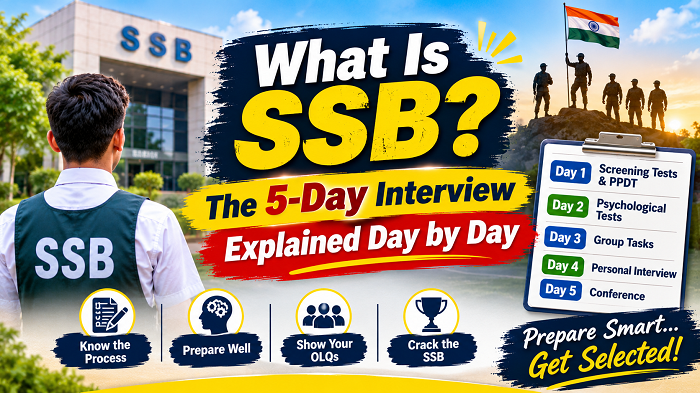
You studied for months. You cleared the NDA written exam. Then a call letter arrives with three letters on it: SSB. Most students feel a rush of pride, then a wave of fear. What happens in those five days? What are they really testing?
Here is the honest answer. The SSB interview process does not test how much you have memorised. It tests who you are. Over five days, trained officers and psychologists watch how you think, how you speak and how you act. They want to see if you can be trained into an officer.
This guide walks you through every day, in order. By the end, you will know exactly what to expect, so the fear turns into a plan.
|
Day |
Stage | What happens |
| Day 0 | Reporting | Document check, chest number |
| Day 1 | Stage 1 screening | OIR test + PPDT (story and group discussion) |
| Day 2 | Psychology | TAT, WAT, SRT, Self Description |
| Days 2–4 | Personal interview | One-on-one with the Interviewing Officer |
| Days 3–4 | GTO tasks | 9 group and outdoor tasks |
| Day 5 | Conference | Final board meeting and results |
Image suggestion: A young aspirant in formal dress holding an SSB call letter outside a selection centre gate. Alt text: “NDA aspirant reporting for the SSB interview process at a selection centre”.
What is SSB, and what is it looking for?
SSB stands for Services Selection Board. It is the 5-day selection test for anyone who wants to become an officer in the Army, Navy or Air Force, whether through NDA, CDS, AFCAT or other entries.
The idea is old and proven. During World War II, the British found that officers chosen only for their background or degrees often broke under real combat stress. So in 1942 they built a scientific selection board to test character and leadership. India adopted the system in 1943, and it grew into today’s SSB.
Three assessors, three windows into you
An old Indian idea explains SSB well: Mansa, Vacha, Karmana, which means thought, speech and action. Each one has its own assessor.
- Mansa (thought): The Psychologist reads your mind through written tests.
- Vacha (speech): The Interviewing Officer (IO) hears how you think aloud.
- Karmana (action): The Group Testing Officer (GTO) watches what you actually do in a team.
The board looks for a match across all three. If your stories say you are brave but your actions on the ground say you hold back, they notice. Being consistent matters more than being impressive.
The 15 Officer Like Qualities (OLQs)
Every test maps to 15 qualities, grouped into four factors.
| Factor | Think of it as | Qualities |
| Planning & Reasoning | Mind | Effective intelligence, reasoning ability, organising ability, power of expression |
| Social Adjustment | Heart | Social adaptability, cooperation, sense of responsibility |
| Social Effectiveness | Guts | Initiative, self-confidence, speed of decision, ability to influence a group, liveliness |
| Dynamic | Limbs | Determination, courage, stamina |
“Right to fit”, not “best to fit”
SSB does not expect you to be a finished officer. Nobody expects a 17-year-old to command troops. The board asks a simpler question: does this person have the raw qualities that the academy can train? That is why honest, average-but-genuine candidates often get recommended while polished, rehearsed ones do not.
Image suggestion: A simple infographic of three circles labelled Thought, Speech and Action overlapping in the middle. Alt text: “Mansa Vacha Karmana framework used in the SSB interview process”.
Day 0 and Day 1: Reporting and Stage 1 screening
Day 1 is the toughest filter of the whole SSB interview process. A large share of candidates is sent home the same evening. Only those who clear screening stay for Stage 2.
Day 0: Reporting
You report to the selection centre, your original documents are checked, and you get a chest number. Carry every document listed in your call letter. A missing original can end your SSB before it starts.
Test 1: Officer Intelligence Rating (OIR)
These are short verbal and non-verbal reasoning questions under tight time limits, much like a reasoning paper. Your result is graded from OIR-1 (outstanding) to OIR-5 (below average).
Many students treat OIR lightly. That is a mistake. A weak OIR score can pull down an otherwise good performance in the next test.
Test 2: Picture Perception and Discussion Test (PPDT)
- You see a hazy picture for 30 seconds.
- In 1 minute, you note the characters: age, gender, mood and action.
- In 4 minutes, you write a story about the picture.
- Each candidate narrates their story aloud in about 1 minute.
- The group then discusses and tries to agree on one common story.
The board watches how you read an unclear situation, how clearly you speak, and how you behave in a group. A shouting, “fish market” discussion helps no one. Calm, clear points that move the group forward stand out.
Image suggestion: A group of 10–12 candidates seated in a semicircle during a PPDT discussion. Alt text: “PPDT group discussion during Stage 1 SSB screening”.
Day 2: The psychology tests (Mansa)
Day 2 is a full day of written tests that reveal how your mind works when you have no time to fake it. Speed is deliberate: the clock leaves room only for your first, natural response.
| Test | Format | What it reveals |
| Thematic Apperception Test (TAT) | 12 pictures, including 1 blank slide; 30 seconds to view, 4 minutes to write each story | Your values, maturity and how you approach problems |
| Word Association Test (WAT) | 60 words, 15 seconds each; write the first sentence that comes to mind | Your spontaneous attitude, positive or fearful |
| Situation Reaction Test (SRT) | 60 real-life situations in about 30 minutes | Practical judgement and decision speed |
| Self Description Test (SD) | 5 short paragraphs: what your parents, teachers and friends think of you, what you think of yourself, and what you want to improve | Self-awareness and honesty |
What students get wrong
- Memorised stories. Assessors have read thousands of coaching-institute stories. A rehearsed blank-slide story sounds rehearsed. Write from your own life.
- The psychologist compares TAT, WAT and SRT. A hero in TAT who avoids every problem in SRT raises a red flag.
- A fake SD. The Interviewing Officer reads your SD before your interview. If it claims qualities you cannot show, the interview will expose it.
Image suggestion: A candidate writing in an exam hall with a projector screen showing a word. Alt text: “Word Association Test during the SSB psychology tests”.
The personal interview (Vacha)
The interview is a one-on-one conversation, usually 30 to 60 minutes, held on one of the afternoons or evenings between Day 2 and Day 4. It is taken by the board President or a senior officer, called the Interviewing Officer (IO).
For NDA candidates, the IO focuses on your school life, family, friends, hobbies, sports and why you want to join. Graduate entries face deeper questions on careers and current affairs.
What the IO usually asks
- Rapid-fire questions. Several questions in one breath: your marks, favourite subjects, family members, friends, hobbies. You must answer them in order. This tests memory and composure.
- Your choices. Why the Army and not the Navy? Why defence and not engineering?
- Current affairs. Big national and world events, and India’s relations with its neighbours.
- Situations and setbacks. How you handled low marks, a failure or a hard decision.
Simple rules that work
- Speak in clear, simple English. Officers work in English at the academy and beyond.
- Dress neatly: formal clothes, short hair, clean shave, polished shoes.
- Never bluff. “Sorry sir, I don’t know, but I will find out” earns more respect than a made-up answer.
- Make sure every answer matches what you wrote in your PIQ form and SD.
Image suggestion: A candidate in formal dress seated across a desk from an officer in a calm interview room. Alt text: “SSB personal interview with the Interviewing Officer”.
Days 3 and 4: GTO tasks (Karmana)
The GTO runs 9 tasks over two days, mostly outdoors, to see how you behave in a team under physical and mental pressure. Wear white PT clothes and white canvas shoes for grip.
| # | Task | What you do |
| 1 | Group Discussion (GD) | Two discussions, usually one social and one current-affairs topic |
| 2 | Group Planning Exercise (GPE) | Solve several problems on a map with limited time, people and resources |
| 3 | Progressive Group Task (PGT) | Cross 4 obstacles as a group using a plank, a log and a rope, following colour rules |
| 4 | Group Obstacle Race (Snake Race) | Carry a cloth “snake” over 6 obstacles as a team, with a war cry |
| 5 | Half Group Task (HGT) | Same idea as PGT, with half the group, so each person gets more chances |
| 6 | Lecturette | Pick 1 of 4 topics and speak for 3 minutes |
| 7 | Individual Obstacles | Attempt 10 obstacles alone in 3 minutes |
| 8 | Command Task | You lead 2 or 3 candidates of your choice across an obstacle |
| 9 | Final Group Task (FGT) | One last group obstacle together |
How to do well
- The approach matters more than the finish. The GTO cares how you plan, help and lead, not only whether the group crossed.
- Give ideas, not just muscle. Carrying the log without contributing a plan shows effort, not leadership.
- Keep the energy up. A loud war cry in the Snake Race keeps the team together when legs get tired.
- A hard Command Task is a good sign. If the GTO keeps making your task harder, he is often testing a strong candidate further.
Image suggestion: Candidates in white PT kit carrying a plank across a GTO obstacle. Alt text: “Progressive Group Task during GTO tasks at SSB”.
Day 5: Conference and results
On Day 5, all the assessors meet in uniform and decide together who is recommended. Each candidate enters the conference room for a few minutes.
Most questions are light: How was your stay? How was the food? For a borderline candidate, the board may ask one or two situation questions to settle its decision. Then the recommended chest numbers are announced.
After you are recommended
- Pilot aptitude test (CPSS): only for candidates opting for the flying branch. You get one attempt in your lifetime.
- Medical examination: a detailed check at a military hospital over several days. Results are Fit, Temporarily Unfit or Permanently Unfit.
- Final merit list: for NDA, your written marks (out of 900) and SSB marks (out of 900) are added, for a total of 1,800. Your rank decides your joining letter.
Image suggestion: A board of uniformed officers seated at a long conference table. Alt text: “SSB conference on Day 5 where the final recommendation is made”.
Expert insights: what the board actually sees
At Trishul Defence Academy, our SSB Wing is headed by Brigadier Amar Narayan, who served more than 3 years as President of the Services Selection Board at Allahabad and personally interviewed over 3,000 candidates. And Colonel Pankaj Mehrotra, who served more than 10+ years as Deputy President of the Services Selection Board at Allahabad and Bhopal and personally interviewed over 10,000 candidates.
Here are the patterns that experience points to.
Patterns we see again and again
- English is the silent filter. Many strong students are screened out on Day 1 not for lack of ideas, but because they freeze while narrating in English. Daily speaking practice fixes this faster than any trick.
- Rehearsed answers backfire. Assessors are trained to spot borrowed stories and copied SRT responses. Genuine, simple answers score better.
- Small habits show. Punctuality, a tidy bed, how you speak to fellow candidates in the mess. Officers notice character outside the tests too.
- Fitness is a confidence booster. You don’t need to be an athlete, but a student who can run 2.4 km without stopping walks into GTO tasks with far less hesitation.
The real preparation for SSB is not cramming for five days. It is building the habits of an officer over months, so that on test day you simply show who you already are.
Frequently asked questions
How many days is the SSB interview process?
Five days of testing after a reporting day (Day 0). Candidates who do not clear Day 1 screening return home the same day.
Can I prepare for SSB in a few days?
You can learn the format in a few days, but the qualities SSB tests, such as confidence, clear English, teamwork and fitness, take months to build. Start early, ideally alongside your written exam preparation.
Is English compulsory at SSB?
There is no rule against Hindi, but narration, discussions and the interview run largely in English. Clear, simple English gives you a real advantage.
Do I need a sports background to clear SSB?
No. Sports certificates are not required. You need basic stamina and the willingness to try every obstacle. The academy trains you to full fitness later.
Can I attempt SSB again if I am not recommended?
Yes. You can appear again each time you clear the written exam or get a fresh call. Many officers were recommended on their second or third attempt.
Is the SSB interview process the same for girls?
Yes. Women candidates go through the same five-day procedure, with fitness standards suited to them.
Your next step: a free career talk
Now you know what happens on each of the five days. The next question is personal: where do you stand today, and what should you work on first?
That is what our free career talk is for. In one relaxed conversation with our team, you and your parents can:
- Understand the right entry for you: NDA, CDS, AFCAT or others
- Find out which part of SSB needs the most work in your case
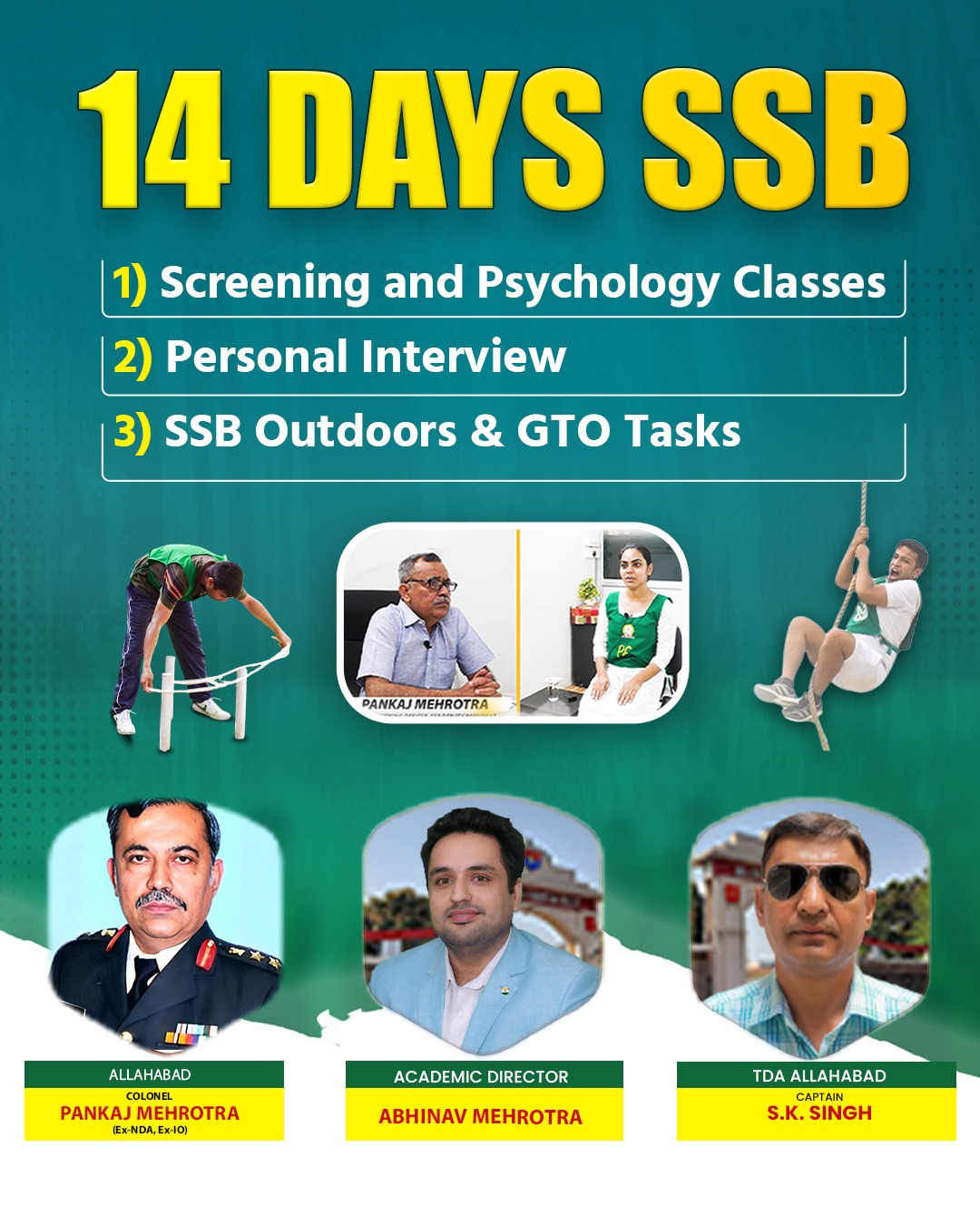
- See how our 14-day SSB training mirrors the real board, from screening to conference
- Ask anything about hostel life, routine and preparation at TDA
No pressure, no obligation. Just clear answers from people who have sat on the other side of the SSB table.
[Book your free career talk →] 8400083030